selectools
R package for trajectory model selection
2026
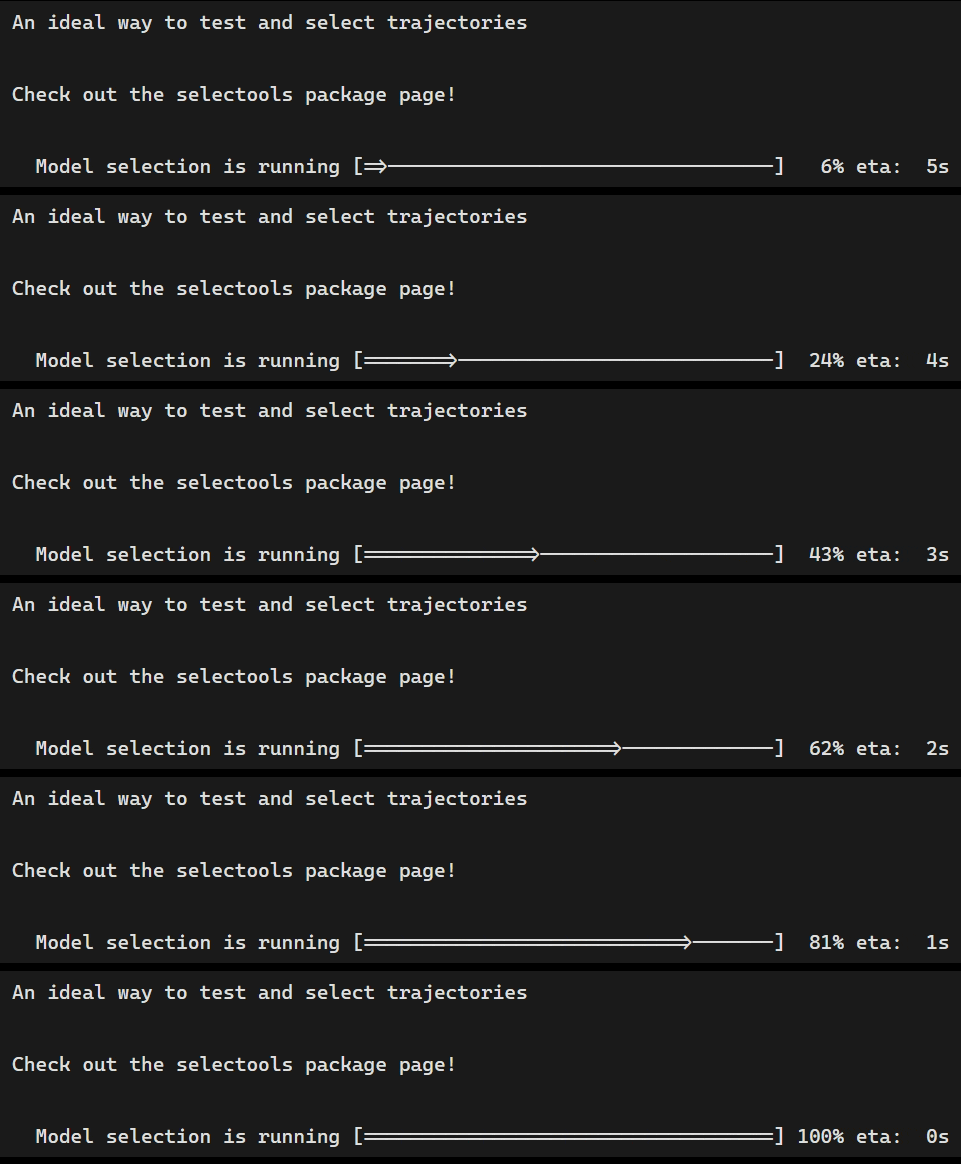
The goal of selectools is to provide and facilitate model selection procedures, mostly based on AIC and AICc, and adapting the MuMIn::dredge() function.
Overview
selectools can be viewed as a two-part package, with on one hand a full pipeline for trajectory analyses, and on the other hand an adaptation of MuMIn::dredge() for phylogenetic model. More specifically, the package contains:
a set of function to perform trajectory analyses. It is designed for model selection from A to Z when testing different trajectories as can be done in senescence research, by automatically computing, fitting, testing, comparing and ranking constant, linear, quadratic, factor and threshold trajectories.
a function to perform model selection of phylogenetic generalized linear mixed models (
phyr::pglmm()). It generates a model selection table of models as would doMuMIn::dredge()with combinations (subsets) of fixed effect terms in the global model, with optional model inclusion rules.
Install from GitHub
Functions
Trajectory model selection pipeline
trajectory_formulas()
Define your formula structure (formula), excluding the trait for which different trajectories should be tested (trajectory_trait). Define terms interacting with trajectory_trait (interactions). Provide the data.frame containing all variables described in formula, trajectory_trait and interactions. Finally, define which trajectories should be built (trajectories, defaults to "all" but choose among "constant", "linear", "quadratic", "factor" - or "non-threshold" for all four non-threshold trajectories -, "thresholdCS", "thresholdSC", "thresholdSS" - or "threshold" for all three threshold trajectories). It returns an object of class trajectory.formulas containing all trajectory formulas selected.
trajectory_formulas(
  formula,
  trajectory_trait,
  interactions = NULL,
  data,
  trajectories = "all"
)

# Print S3 method
print(x, ...)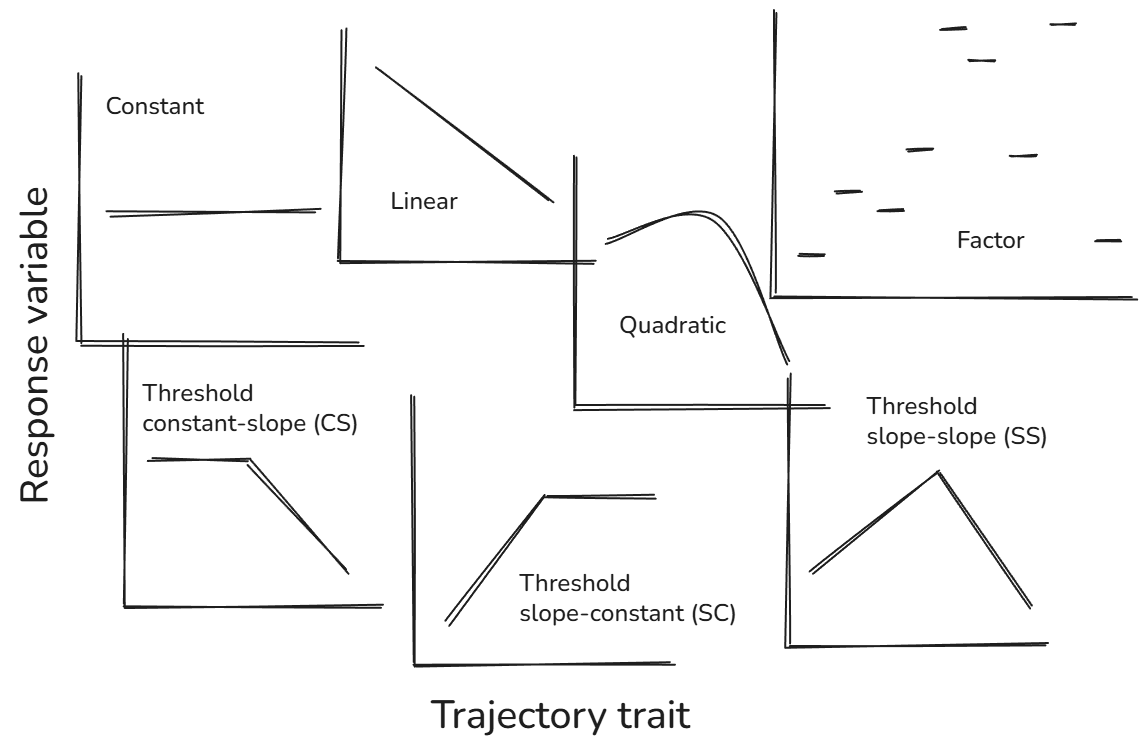
estimate_threshold()
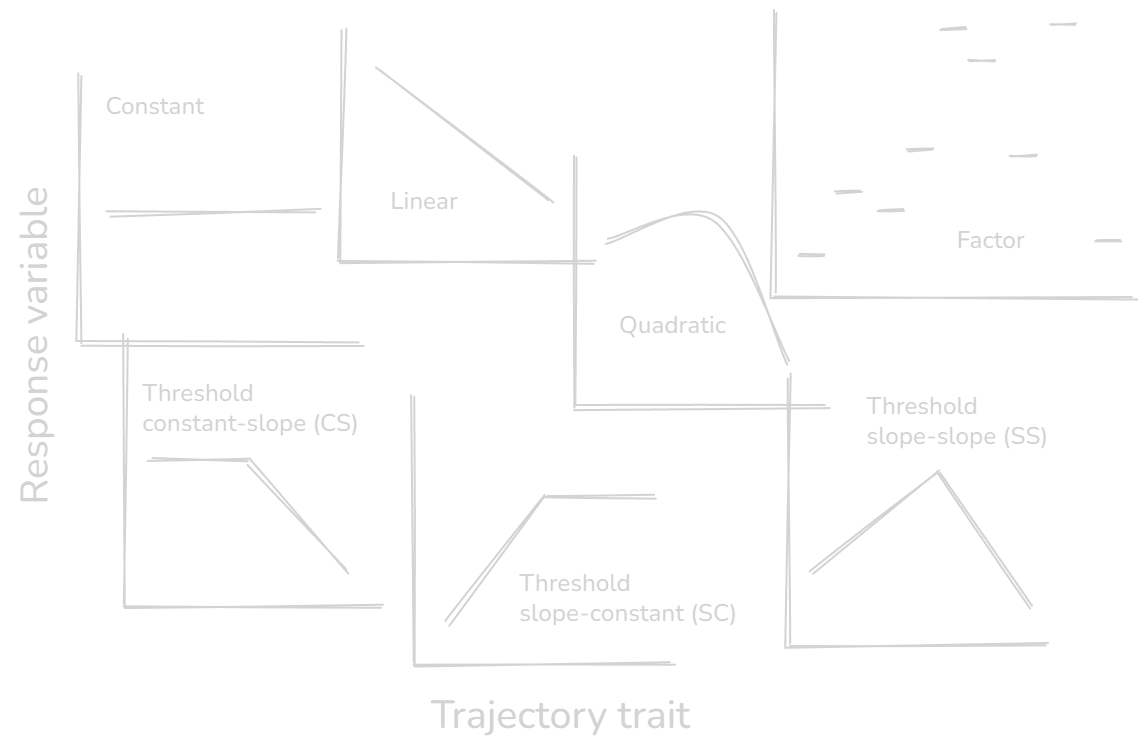
threshold_formulas takes either the trajectory.formulas object generated by trajectory_formulas() or a named list of threshold formula object. start, end, iter specifies where to start, end and how to increment threshold point tests. lmer_control should ideally stay NULL (default). If no random effects, then lmer_control is NULL, otherwise it refers to the internal object lmerControl_default which uses Bound Optimization BY Quadratic Approximation, “bobyqa” and 1e5 as maximal number of evaluation. Advanced users can supply custom optimizer controls for lmerMod class objects. Returns a threshold.estimation object containing a list of the best threshold point for each threshold trajectory. The plot S3 method allow to consult plots of AIC/AICc values according to threshold values for each trajectory.
estimate_threshold(
  data,
  threshold_formulas,
  trajectory_trait,
  start,
  end,
  iter,
  rank = c("AICc", "AIC"),
  lmer_control = NULL
)

# Print S3 method
print(x, ...)

# Plot S3 method
plot(x, model = c("thresholdCS", "thresholdSC", "thresholdSS"))rank).
fit_model()
formulas takes either the trajectory.formulas object generated by trajectory_formulas() or a named list of formula object to be tested. If formulas includes threshold formulas, best_thresholds takes either a threshold.estimation object obtained with estimate_threshold() or a named list of numeric values specifying threshold points. Returns a models object containing all trajectory model fits and an attached environment with threshold datasets (i.e. copies of data with trajectory_trait recalculated according to threshold points).
fit_models(
  formulas,
  trajectory_trait,
  data,
  best_thresholds = NULL,
  lmer_control = NULL
)

# Print S3 method
print(x, ...)lme4::lmer() or stats::lm() models for all trajectories, accounting for threshold estimations obtained by estimate_threshold().
dredge_trajectories()
models is an object generated by fit_models(), exclusively. delta_criterion is a numeric value that is used to select the subset of best models. The best model is selected as the model with the lowest number of parameters (df) among models below delta_criterion (either delta_AICc or delta_AIC). Delta is the difference between the criterion (AIC or AICc) value of a given model, and the criterion of the model with the lowest criterion value. Returns a dredge.results object containing model.selection tables (either complete, subset below delta_criterion or best model).
dredge_trajectories(
  models,
  trajectory_trait,
  rank = c("AIC", "AICc"),
  delta_criterion = 2,
  data
)MuMIn::dredge() function to each model trajectory. For each trajectory (constant, linear, quadratic, factor, thresholds), the function selects the best model based on criterion (rank = "AIC" or rank = "AICc") value.
best_trajectory()
dredge_results is a dredge.results object obtained with dredge_trajectories(), exclusively. adjust_threshold is a logical argument stating whether 1 number of parameters and 2 AICc/AIC values should be added for threshold models to account for the implicit cost of the threshold parameter (defaults to TRUE). Returns a best.trajectory object containing recap and summary information of selected trajectory.
best_trajectory(
  dredge_results,
  delta_criterion = 2,
  adjust_threshold = TRUE
)

# Print S3 method
## prints a recap of the best trajectory (type = "global") or the best model of
## each trajectory (type = "by_trajectory")
print(x, type = c("global", "by_trajectory"))

# Summary S3 method
## prints a summary of the best model trajectory (type = "global") or the best model of
## each trajectory (type = "by_trajectory")
summary(x, type = c("global", "by_trajectory"))
select_trajectory()
All arguments have been described above. Returns a best.trajectory object containing recap and summary information of selected trajectory.
select_trajectory(
  formula,
  trajectory_trait,
  interactions = NULL,
  data,
  trajectories = "all",
  start, end, iter,
  rank = c("AICc", "AIC"),
  delta_criterion = 2,
  adjust_threshold = TRUE,
  lmer_control = NULL
)

# Print S3 method
## prints a recap of the best trajectory (type = "global") or the best model of
## each trajectory (type = "by_trajectory")
print(x, type = c("global", "by_trajectory"))

# Summary S3 method
## prints a summary of the best model trajectory (type = "global") or the best model of
## each trajectory (type = "by_trajectory")
summary(x, type = c("global", "by_trajectory"))Phylogenetic model selection
dredge_pglmm()
Define your random effects (formulaRE), fixed effects (fixed), data, model selection criterion (rank: AIC or AICc), distribution family (gaussian , binomial or poisson), the covariance matrix of the random effects (cov_ranef, i.e. usually an object of class phylo) and whether to display estimates and/or standard-errors.
dredge_pglmm(
  formulaRE,
  fixed,
  data,
  rank = c("AICc", "AIC"),
  family = c("gaussian", "binomial", "poisson"),
  cov_ranef,
  estimate = T,
  std.err = F,
  round = 3
)Resources
All documentation and source code for the selectools package can be found on my GitHub page.
License
This package is under the MIT License.
Citation
To cite the selectools package in your publications, please use:
selectools v0.3.0
Lalande LD (2026). selectools: A facilitating model selection procedure. R package version 0.2.1. 10.5281/zenodo.20378446.
For the canonical citation of the software project, use the concept DOI:
This package has been cited in:
Cambreling S, Ronget V, Remot F, Gaillard J-M, Lemaître J-F. (2025). Male reproductive senescence in mammals is pervasive and aligned with the slow-fast continuum. Ecology Letters. 28, e70194. 10.1111/ele.70194